
The project is also considered a flagship initiative designed to serve as a model for other companies. It receives partial funding through subsidy programs provided by the German Federal Ministry for Economic Affairs and Climate Action. Lars Dammann, Head of Occupational Safety and Environmental Protection at DMK, explains how the system works.
Milk processing is an energy-intensive industry. For example, the milk delivered by our farmers must be heated and subsequently cooled again for hygiene reasons. We use steam generated by our own combined heat and power plant as the heat source. While the facility was already state-of-the-art, additional optimization measures have enabled us to make much better use of waste heat.
Because heating and cooling processes are required throughout many areas of production, we looked for new ways to both reduce energy consumption and improve operational efficiency at the same time.
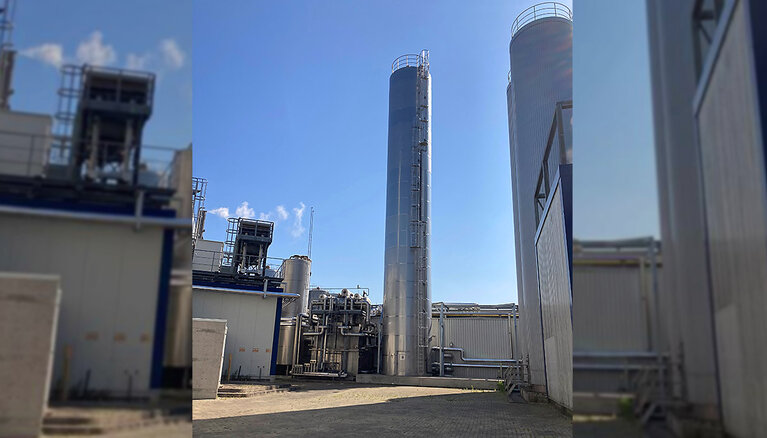
The key elements of the upgrade include intelligent heat recovery from exhaust air, a thermal storage tank for more efficient use of waste heat, and the use of hot water wherever possible.
For example, an improved heat exchanger allows us to utilize the warm exhaust air from the combined heat and power plant much more effectively. The recovered thermal energy, together with heat obtained from other production processes, is stored in a so-called stratified thermal storage tank with a capacity of 300,000 liters.
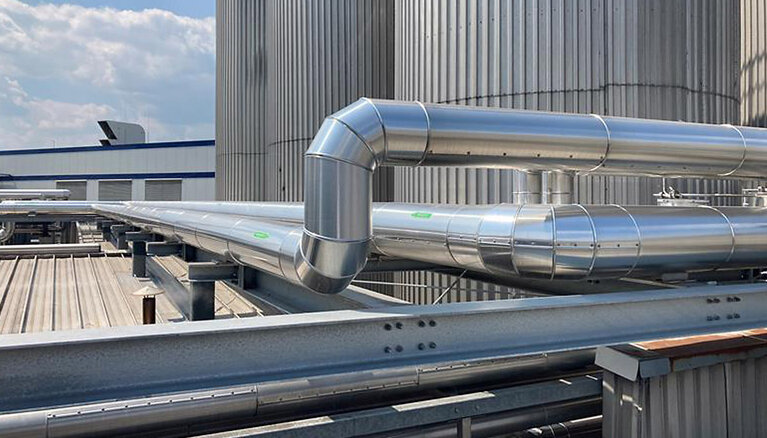
The stored heat is then distributed through a dedicated piping system (see photo) and fed into the site's heating circuits as required, such as the 60°C and 45°C networks. Many processes in our dairy operations do not require high-temperature steam. These so-called “heat swing systems” intelligently connect heat sources and heat sinks, significantly reducing overall energy consumption.
In addition to recovering heat, these systems can also support cooling processes. The generation of process cooling is highly electricity-intensive. As a result, the new system also reduces the site's electricity demand.
The system has been in operation since March 2023 and delivers substantial energy savings of up to 28 million kWh per year.
In 2025, the concept demonstrably reduced CO₂ emissions at the Edewecht site by 5,436 tonnes. As prices for fossil fuels and carbon certificates are expected to continue rising, we see this project as a model for many other manufacturing companies with similar technical infrastructures.
DMK also plans to transfer the efficiency measures developed in Edewecht to additional sites, including Zeven and Nordhackstedt. New technologies such as heat pump systems will also be implemented as part of these efforts.

One of the biggest challenges was carrying out the modifications while maintaining normal operations. A dairy processing facility cannot simply be shut down and restarted at will.
The project became particularly complex during the installation of the pipelines for the different hot water circuits. For structural reasons, it was not possible to route the pipes along the existing pipe bridge as originally planned. Instead, the lines had to be installed across the entire site.
Another challenge was the sharp increase in construction costs, as well as rising prices for metals and technical equipment throughout the course of the project. Despite these obstacles, the project was successfully completed and is already delivering measurable environmental and economic benefits.
